

Optical Satellite Communication: Who Builds the Terminals
The market for gigabit-class space optical terminals has matured rapidly, with roughly 30,000+ terminals already in orbit


We at Space Ambition provide DeepTech advisory services. Whether you represent a VC, family office, corporation, ecosystem builder, government agency, or startup, we’d be happy to assist you with your needs. Please contact our co-founder Denis Kalyshkin via denis@spaceambition.org.
P.S.: If you want to get an extended version of this article, please contact Dr. Ivan Khrapach via ivan@spaceambition.org.
In our previous articles, we’ve discussed why the domain of optical (laser) communication is essential for space exploration and the space economy. Today, we’ll discuss the companies that make terminals for such communications. Terminals, along with ground infrastructure, relays, and specialised software, are an important part of this domain. Therefore, they are essential, for example, for space-based data centers, which are of interest to many in light of the upcoming giant IPO of SpaceX.
The market for gigabit-class space optical terminals has matured rapidly. Within a decade of commercial development, roughly 30,000+ terminals are already in orbit (most are on Starlink satellites), a dedicated public company, Mynaric, has formed around the technology, and M&A activity signals active vertical integration. This is a multifaceted market with real capital, competition, and real infrastructure in space.
In April 2026, Mynaric — the most-watched European laser-communications company — was absorbed by Rocket Lab after a German restructuring that wiped its shareholders to zero. This is the first public failure in the optical-terminal industry, and it changes how every other company in this layer should be evaluated. This piece explains what an optical terminal actually is, who builds them in mid-2026, why Mynaric’s collapse is multi-causal, and what readers should take from the story.
Why the Mynaric case matters
Through August 2024, Mynaric was the European challenger that European space policy needed: a publicly listed terminal OEM (Original Equipment Manufacturer) with a backlog from the US Space Development Agency (SDA — the US Department of Defence agency procuring the Proliferated Warfighter Space Architecture, effectively setting the standard for the US optical-comms market). SDA’s constellation cohorts are called Tranches; by June 2025, Mynaric had delivered more than 100 CONDOR Mk3 terminals for Tranche 1. At the same time, Mynaric was undergoing restructuring: by April 2026, Rocket Lab (Nasdaq: RKLB) had closed the acquisition for a total consideration of ~$160 million in cash plus 2.27 million Rocket Lab shares. Prior shareholders received nothing.
The scalability part is what actually went wrong. By June 2025, Mynaric was delivering terminals for the Tranche 1 set, the photonics worked. The unit economics did not: each terminal took longer and cost more to align than bids assumed; the publicly listed structure left no patience for a multi-year yield ramp; and revenue concentration above 90% on a single customer (SDA) frightened off acquirers — Rheinmetall withdrew its bid in March 2026, citing not the price but the regulatory paperwork and customer-mix risk. This was a confluence — public-market pressure, capital intensity, single-customer concentration — that publicly listed European OEMs have struggled to survive without state backing. Each factor is survivable alone; the combination creates substantial structural risk.
Anatomy of an optical terminal
If the photonics worked and the production did not, it would help to know what is actually inside the box. An optical communications terminal (OCT) is the in-orbit hardware that takes data from a spacecraft’s onboard computer and emits it as a beam of infrared light aimed at another terminal — on another satellite, on the ground, or, in the future, on the Moon.
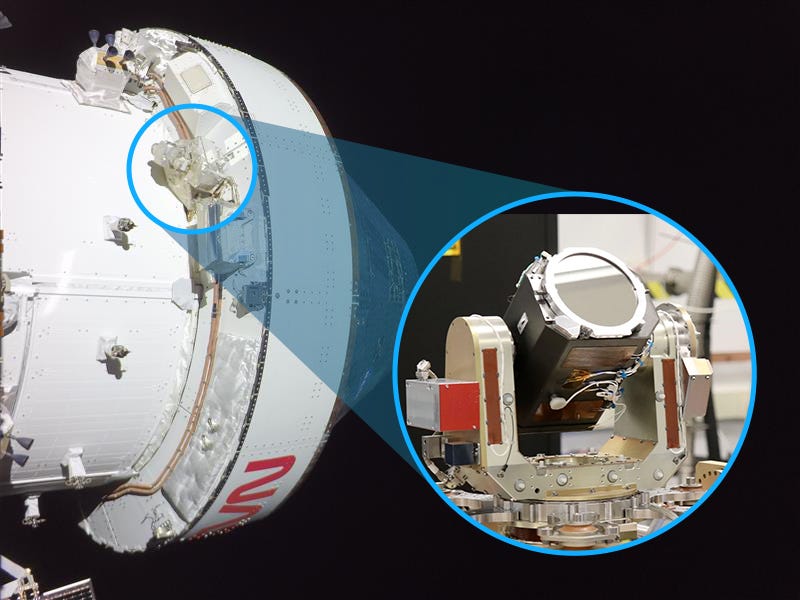
The light source is a narrow-linewidth laser, almost always at 1550 nm (the wavelength used in submarine fiber-optic cables) or, for some deep-space systems, at 1064 nm. The 1550 nm choice sits in an atmospheric transmission window, is eye-safe, and lets the industry borrow components from the terrestrial fiber market. The outgoing beam has a divergence of ~20 microrad, that is, a beam from 1,000 km away covers a spot about 20 metres across on the ground. This is what gives optical the ability to transmit an immense amount of data, enables security advantages (beam delivery exclusively to the recipient makes them difficult to intercept), and at the same time, makes the engineering hard.
To keep that narrow beam pointed at a moving target, the terminal uses a two-stage pointing system. A coarse-pointing gimbal — a motorised cradle that rotates the whole optical head — handles slow movement. A fast-steering mirror (or its analogue) inside the optics handles small, rapid corrections to compensate for spacecraft vibration or atmospheric distortions. A beacon-tracking subsystem often locks onto a wider-divergence pilot signal from the other end of the link and feeds the pointing system a reference.
On the receive side, a similar telescope collects incoming light, focuses it into a single-mode fiber, and feeds it to a detector — an avalanche photodiode (APD) for near-Earth links, or a superconducting nanowire single-photon detector (SNSPD) for deep space, where each photon counts. A coherent modem carries information in the optical phase (BPSK, QPSK) for very high bit rates; a non-coherent modem uses simple intensity modulation and is slower but more robust.
It is common for terminals to use a single shared optical telescope to transmit and receive laser beams simultaneously. The system then uses a beamsplitter or optical circulators to separate the outgoing high-power transmission beam from the incoming low-power signal. This setup is called Full Duplex.
To extend communication range, increase available bandwidth, and improve overall link reliability in free-space optical networks, adaptive optics systems are often used. By continuously sensing and correcting atmospheric turbulence effects, they minimise signal degradation in optical links.

The economically hard parts of this stack is not the laser, modem, or detector — those are catalogue items from the fiber-optic industry. The expensive, low-yield steps are the precision optomechanics: the beam-steering MEMS (micro-electromechanical systems), the fast-steering mirror, and the alignment that keeps the transmit and receive optical axes parallel to within a few microradians under launch loads, thermal gradients, and years of vibration. This is where serial production often fails.
The primes that ship
In mid-2026, a dozen Western companies deliver OCTs at industrial cadence.
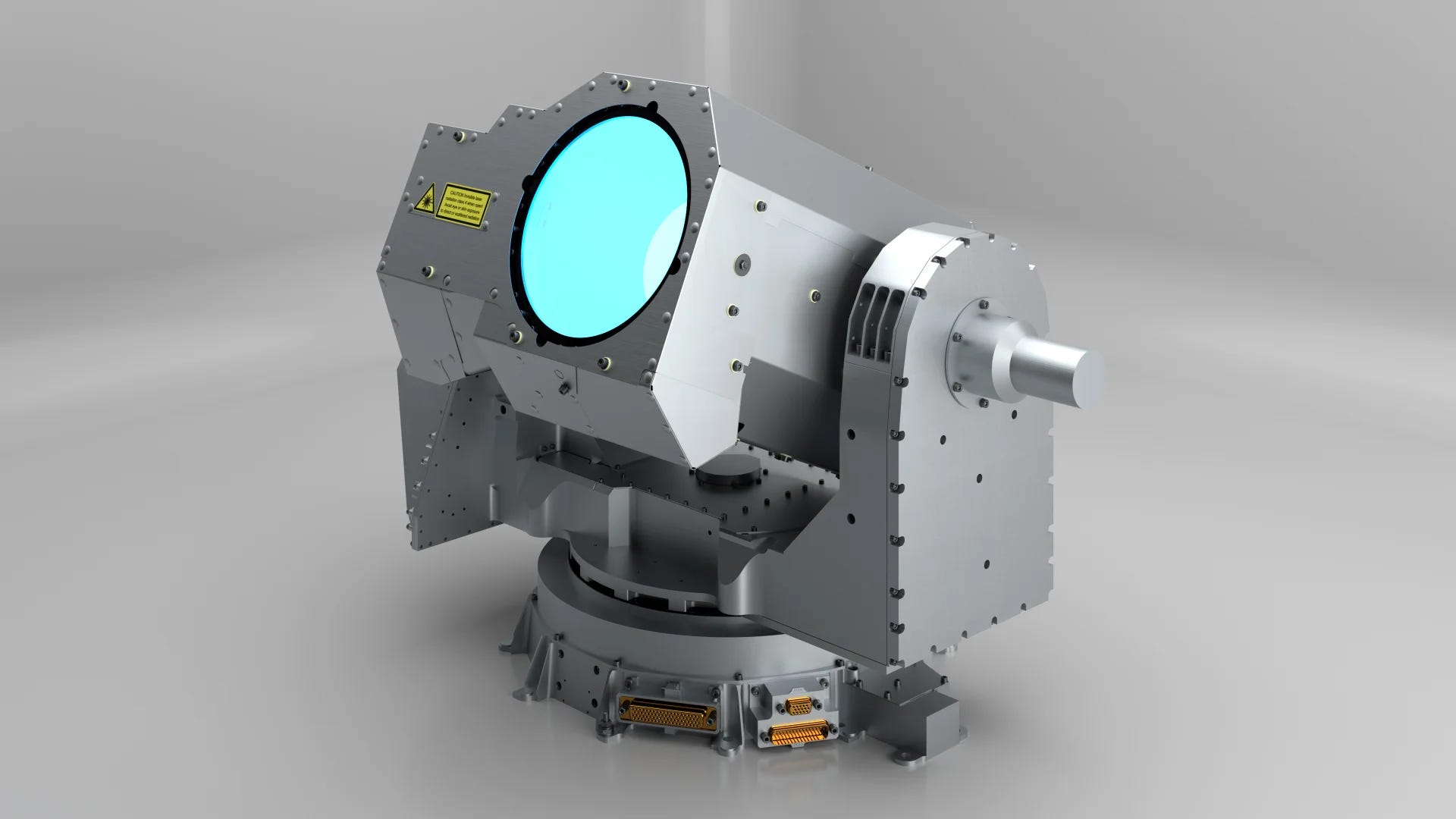
Tesat-Spacecom (an Airbus subsidiary in Backnang, Germany) provides the SCOT product family, which covers three orbit regimes: SCOT20 for CubeSats (100 Mbps, 1.7 kg), SCOT80 for LEO meshes (10 Gbps, ~12 kg), and SCOT135 for MEO/GEO (2.5–100 Gbps, 28 kg). The Backnang series-production facility opened in August 2024 with a capacity for ~100 units a month — up from one per year a few years earlier. Tesat was selected by MDA Space in May 2024 to supply 792 OCTs, seemingly the largest single OCT order to date.
CACI International ships CrossBeam — 1.25 or 2.5 Gbps, on orbit since June 2021, the longest-flown American-made terminal. CACI, together with SpaceX, was first to successfully demonstrate a cross-vendor laser communications link in 2025, later advancing into Phase 2 of the US Space Force Enterprise Space Terminal programme alongside GA-EMS (General Atomics Electromagnetic Systems) and Viasat.
GA-EMS builds a multi-mission terminal enabling up to 5 Gbps. On 2 September 2025, GA-EMS performed a cross-vendor air-to-space link between its aircraft terminal and a Tesat terminal on a Kepler Communications satellite.

The fourth prime is Mynaric under Rocket Lab; CONDOR Mk3 production continues, and Mk3.1 (targeting 100 Gbps) is on the development path.
The vertically integrated outliers
SpaceX builds Starlink’s optical inter-satellite-link terminals in-house, and about 9,000 satellites, each having 3 to 4 optical terminals, are in orbit by mid-2026, moving on the order of hundreds of petabytes of subscriber data a day. They were not available externally until recently, when Muon announced an agreement with SpaceX to integrate its mini laser terminals (up to 25Gbps over up to 4,000 km) into Muon’s high-performance Halo satellite platform. Now SpaceX markets its terminals under the “Plug and Plaser” brand, often with access to a broader service via the Starlink satellite and ground station network.
Amazon’s Project Kuiper builds its own terminals in-house and demonstrated 100 Gbps over 1,000 km in late-2023 testing. OneWeb also has an in-house terminal under consideration. These hyperscale-funded operators keep their terminals captive; everyone else buys from the merchant market.
Europe, Japan, and the multi-bloc map
Outside Tesat, the European picture is narrow but active. Thales Alenia Space leads IRIS² (optical inter-satellite links needed) and the CNES-funded SOLiS GEO 1 Tbps demonstrator, and is prime on ESA’s HydRON optical network.
Japan is more present than English-language coverage suggests. Sony Space Communications has a deal with Astro Digital to fly two demonstration satellites carrying its terminals; ArkEdge Space is to develop its own terminal. Japan already operates an EDRS-class GEO relay — JAXA’s JDRS with the NEC/JAXA LUCAS payload delivers 1.8 Gbps to ground since 2020; NICT’s HICALI on ETS-9 is set to extend that to 10 Gbps in 2026.
The UK has a pipeline: Spire OCT was the first UK-sourced terminal developed. The ALIGN mission with the FOCUS payload (Northumbria, Durham, e2E/Telespazio-UK, SMS Electronics, funded by UKSA) will demonstrate autonomous LEO-to-LEO links up to 1,000 km in two 6U CubeSats, representing the second terminal to be developed in the UK.
China, Russia, and India belong on the map and demonstrate that optical communications by 2026 is one of the few space technologies that is genuinely multi-bloc rather than US-dominated.
One operational Chinese builder ships terminals into its own constellation: Chang Guang Satellite Technology (CGST), operator of the Jilin-1 fleet, flew a 100 Gbps space-to-ground link from Jilin-1 02A02 in December 2024 — the highest publicly disclosed space-to-ground bit rate of any operator.
Standards have effectively become the moat — within one market
For vendors selling into the US defence market, the SDA Optical Communications Terminal Standard has effectively become the gatekeeper. Version 3.0.1 was the first hard interoperability mandate; v3.2.0 (March 2025) is the Tranche 3 standard of record; v4.0.0 introduces a burst-mode variant for a later cohort. The versions are not deprecations of one another — each is a profile targeted at a specific Tranche, and they are backward-compatible. Outside the US defence market, customer-specific procurement remains the binding instrument: China’s national constellations operate under their own framework; ESA-led programmes such as IRIS² lean on CCSDS standards (international civil/scientific baseline used by NASA, ESA and JAXA).
The market for gigabit-class optical communication terminals has evolved from an emerging technology into a large-scale commercial industry. In less than a decade, it is an industry with four primes, SpaceX as a vertically integrated outlier, acquisitions, public failures, and cross-vendor in-orbit links.
However, the industry’s first major commercial failure highlighted a critical challenge: manufacturing scalability. The underlying photonics technology performed as intended, but production costs and assembly complexity exceeded expectations. Terminal alignment proved more expensive than anticipated, undermining unit economics and preventing the company from achieving the production scale required for profitability. The lesson here is softer than “do not be public, capex-heavy, and single-customer”. Each feature is survivable on its own, the combination is harder.
Fascinating article - thanks for writing
RHEINMETALL did not, or could not make a bid. RKLB had a "material" contract with Mynaric since 2025.
Use better sources for your content, not 2nd rate journalists.
Disappointing, couldn't read past that crap.