



Issue 173. Subscribers: 89 058
We are witnessing a unique moment in history: for the first time, several teams are simultaneously building superheavy rockets. On May 22, SpaceX conducted the 12th test flight of Starship — the debut of the upgraded V3 version. The vehicle reached space, but the booster failed: the FAA suspended flights and ordered an investigation. Six days later, on May 28, Blue Origin’s New Glenn exploded on the launch pad during a static fire test. The launch complex was destroyed, and a return to flight has been pushed back by several months at minimum.
Against this backdrop, the SLS stands apart. The rocket is expendable, and costs roughly $4 billion per launch — yet it has already flown successfully twice: first on the uncrewed Artemis 1, and in April of this year, for the first time in half a century, it carried a crew around the Moon.
SLS is often dismissed as overpriced, outdated, and unambitious. And on paper, that’s fair. But there’s a more interesting story underneath: how NASA made a deliberate bet on proven, battle-tested technology — and why that bet, despite all its costs and compromises, is the reason the rocket flew twice while its more modern competitors are still working through failures on the pad. That’s what this article is about.
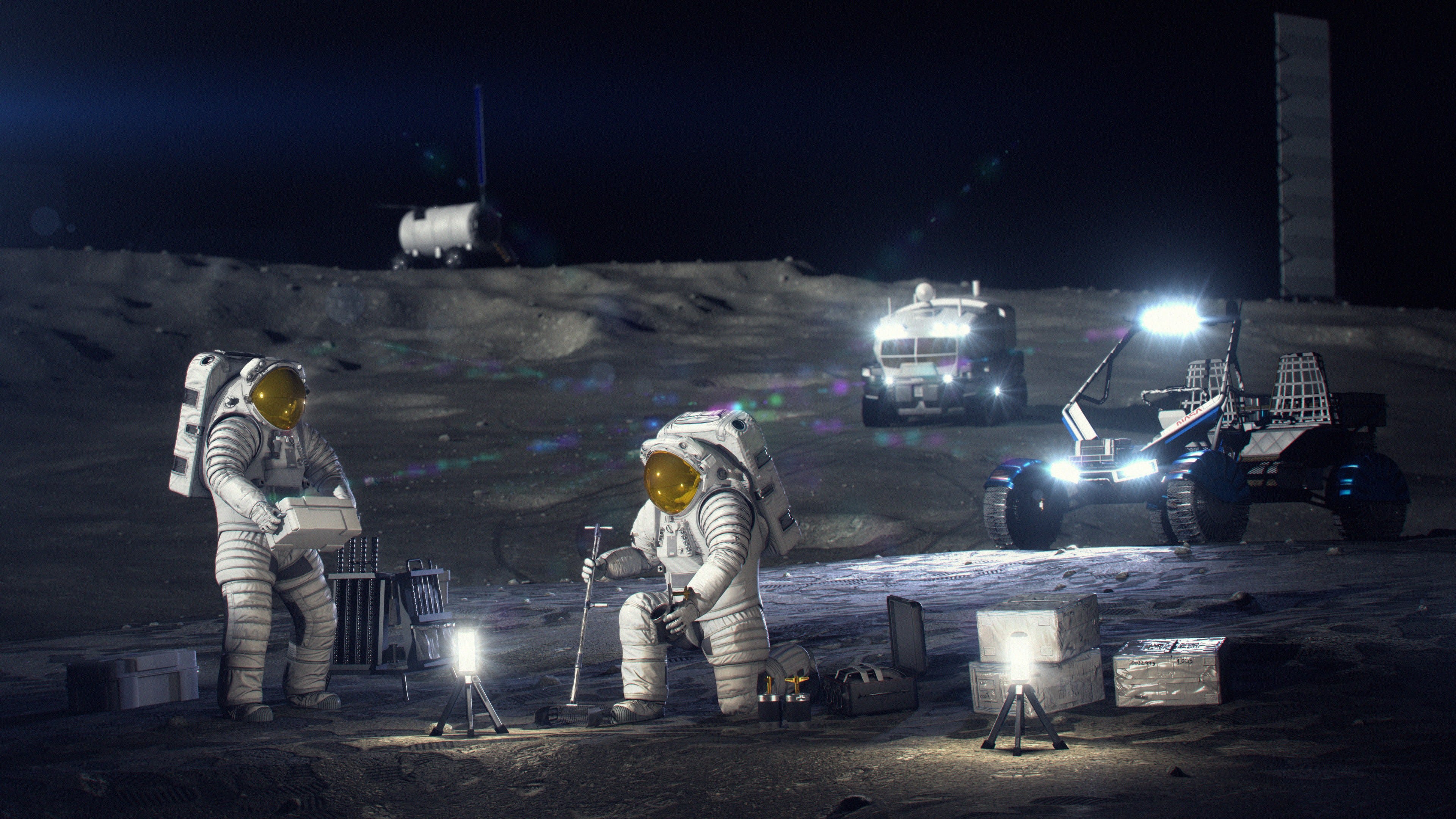
The SLS: NASA’s Engineering Frankenstein
The Space Launch System is a superheavy rocket built for crewed missions beyond low Earth orbit. In its baseline Block 1 configuration, it can deliver roughly 95 tons to low Earth orbit and 27 tons on a trajectory to the Moon — life support systems, heat shield, fuel tanks, engines, and everything else the mission requires.
Strip away the marketing, and the SLS turns out to be a rather unusual vehicle. The SLS is a case study in how modern spaceflight programs are built: from whatever already exists, balancing reliability, schedule, and politics.
Why? To understand that, you have to go back a bit.
After Apollo ended in 1972, NASA shifted its focus to the Space Shuttle — a reusable vehicle, replacing the model where every mission required a brand new rocket. The Shuttle era contributed enormously to spaceflight, but reusability never delivered on its economic promise: launches remained expensive. And after the Challenger and Columbia disasters, it became clear the system was also unsafe. The program was shut down in 2011, as soon as the Shuttle’s role in completing the ISS was finished.
That left NASA without its own crewed launch capability — and forced to buy seats from Roscosmos to get astronauts to the station. But the ambition never went away. Astronauts were living on the ISS for six months at a time, technology was advancing, and the goals were growing. The Moon was back on the agenda, Mars was on the horizon — yet there was no rocket capable of getting there, and building one from scratch kept running into budget and political constraints.
So when NASA decided to build the SLS in 2011, the logical move was to reuse as much of the Shuttle program as possible. The infrastructure was already there, so were the components.
Sometimes it’s easier to start from scratch than to figure out systems that are already in use. But zoom out, and the compromise actually makes sense: proven technology reduces risk, existing factories accelerate the program, and contractors get a steady flow of government work.
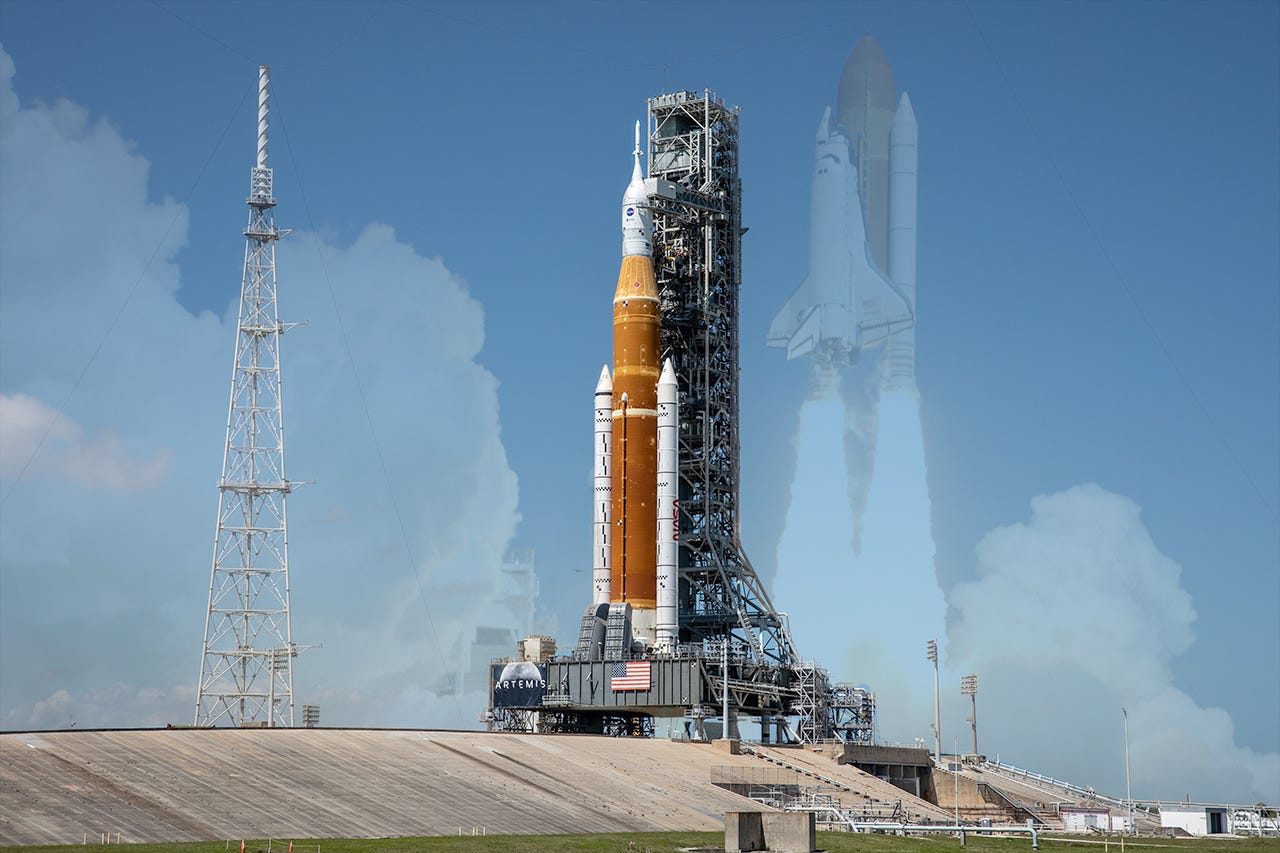
What the SLS Inherited from the Space Shuttle
To simplify, there are key inherited solutions:
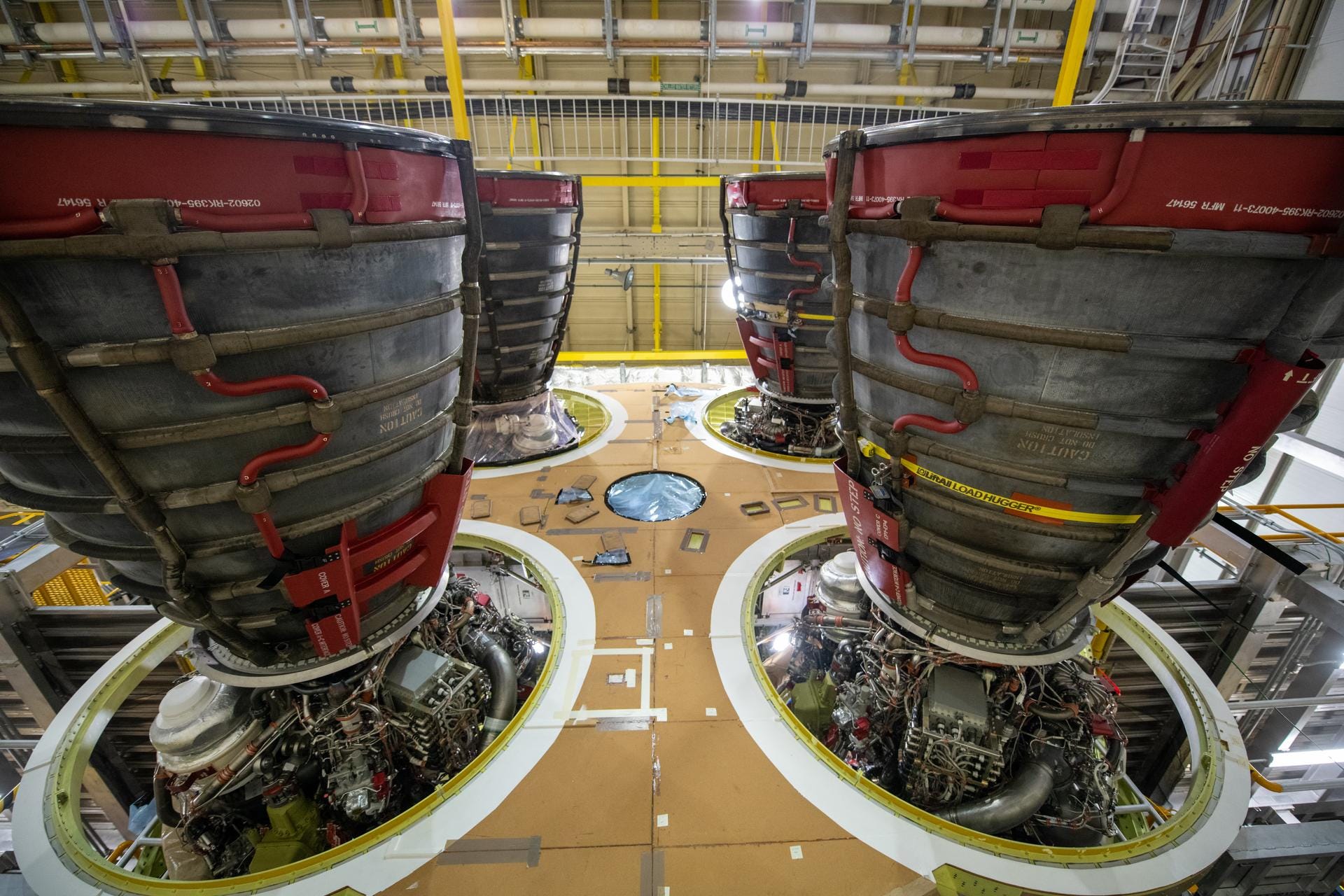
RS-25 engines —the same engines that powered the Shuttle orbiter itself, firing from the moment of liftoff
Solid rocket boosters — upgraded versions of the Shuttle’s side boosters (SRBs).
This is more literal than it sounds. When the Shuttle program ended in 2011, NASA removed the RS-25 engines from the retired orbiters and put them in storage. Three of the four engines on Artemis 2 are those same engines — physically — refurbished with modern computers and new insulation, but the same hardware. One of them, E2047, had flown 15 previous missions, including the final Shuttle flight in July 2011. Congress effectively mandated this approach in 2010, instructing NASA to build the new rocket using “existing United States propulsion systems.”
I’ll go through each in turn. Starting with the engines, because they are the foundation of any rocket — everything else in the design flows from them.
Massive Tanks and Cryogenic Cold: Why the SLS Runs on Hydrogen
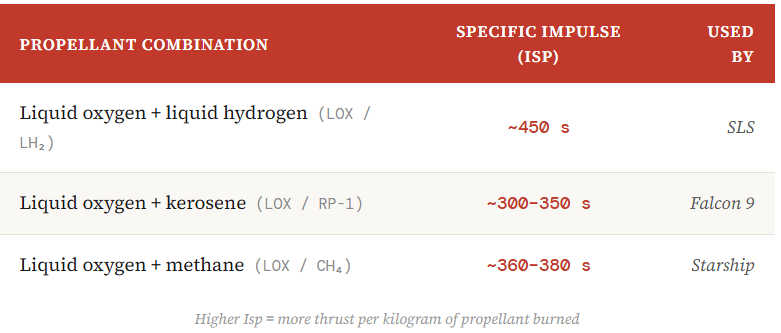
The SLS runs on a combination of liquid hydrogen (LH₂) as fuel and liquid oxygen (LOX) as oxidizer. This pairing delivers the highest specific impulse (Isp) of any propellant combination in use in modern rocketry.
Hydrogen, however, comes with serious engineering challenges. It is a cryogenic propellant that must be stored at an extremely low temperature — around −253°C. Even the smallest slit in a tank can cause a leak: hydrogen molecules are so small they will pass through any micro-crack. Its low density also demands enormous tanks, which add mass and complexity to the overall design. At these temperatures, metals become brittle, and the risk of fractures and deformation increases.
These challenges have already shown up in practice: in February 2026, during Artemis 2 launch preparations, engineers discovered hydrogen leaks that forced a delay. Liquid hydrogen caused problems during Apollo too — but safety requirements were less strict back then, and launch delays were more tolerated. Standards tightened significantly after the Shuttle disasters.
Today, engineers take a more pragmatic view of hydrogen than they did in the Shuttle era. When you factor in the cost of production and storage, the complexity of cryogenic infrastructure, and the weight penalty of oversized tanks, the specific impulse advantage starts to look less compelling. In the real-world tradeoff between efficiency, complexity, and mass, hydrogen often loses out to kerosene and methane — which is why it is used so rarely today.
So why does the SLS still run on hydrogen? Because the technology was already proven on the Space Shuttle. Switching to a different propellant would have meant building the rocket from scratch.
Massive Thrust and Uncompromising Reliability: The Case for Solid Rocket Boosters
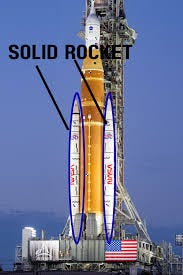
The solid rocket boosters follow the same logic — another piece of Shuttle heritage. Back in the 1970s, liquid-fueled boosters simply couldn’t match the required thrust: achieving the same performance would have meant a dramatic increase in mass and cost.
So NASA went with the familiar approach: took the Shuttle’s solid boosters and scaled them up by roughly a quarter to deliver the velocity needed for a lunar trajectory.
The tradeoff is real, though. Solid propellant has hard limitations: once ignited, the engine cannot be shut down. Thrust is fixed and cannot be throttled, which makes the vehicle harder to control. Think of a car that’s always running at full throttle with no way to ease off the accelerator — that’s roughly what it looks like. But for both the Shuttle and the SLS, that compromise was worth it: the enormous liftoff thrust and proven reliability matter more than fine control in the first minutes of flight.
You might be wondering: if the SLS and the Space Shuttle have so much in common, why not just take the Shuttle stack and bolt Orion on top? Why reinvent the wheel?
If only it were that simple. The Shuttle’s architecture was designed around a winged, returnable orbiter with aerodynamic surfaces — Orion is a sealed capsule with much stricter life support requirements. On top of that, a lunar trajectory demands a different acceleration profile and significantly higher velocities than the Shuttle was ever designed for.
The Third Piece: The Upper Stage That Actually Goes to the Moon
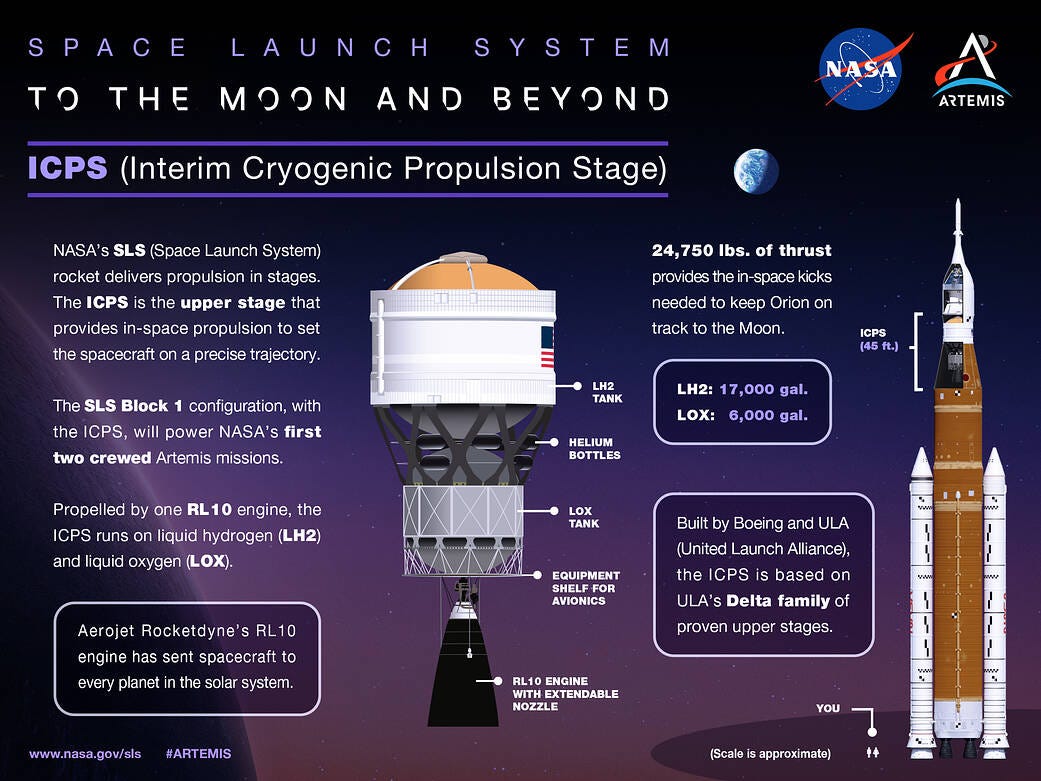
The RS-25 engines and the solid rocket boosters get the SLS off the ground and into low Earth orbit. But reaching the Moon requires one more burn — and that’s the job of the ICPS, the Interim Cryogenic Propulsion Stage.
The ICPS is a single-engine upper stage powered by one RL-10 engine, running on the same liquid hydrogen and liquid oxygen combination as the core stage. After the core stage separates, the ICPS ignites and performs the trans-lunar injection burn — the maneuver that puts Orion on a trajectory toward the Moon. Without it, the rocket is just an expensive ride to orbit.
Interestingly, the ICPS is the one component that does not come from the Space Shuttle. It is a modified version of the upper stage from the Delta IV rocket, built by United Launch Alliance. This is also why it’s called “Interim” — it was always meant as a temporary solution, borrowed from an existing vehicle rather than purpose-built for the Moon.
The more powerful Exploration Upper Stage, originally planned to replace ICPS starting with Artemis 4, was cancelled in early 2026. NASA has since selected the Centaur V as its replacement. The long-term future of SLS beyond Artemis 4 remains politically uncertain — but that’s a story for another article.
The SLS in Action: What Artemis Revealed
As we’ve seen, the SLS is something of a Frankenstein — assembled piece by piece from whatever NASA had on hand. Each component had been tested individually, but together they could behave unpredictably. That’s exactly why flying the rocket and verifying the architecture in real conditions was so important.
That was the purpose of Artemis 1 in November 2022 — an uncrewed lunar flyby that gave engineers an enormous amount of data on how the SLS actually performs:
RS-25 engine behavior during an extended flight
Temperature, pressure, thrust stability, and the synchronization of all four core stage engines firing together with the solid rocket boosters — none of this could be fully verified on a test stand. Only a real flight could show how closely the actual parameters matched the models.
Solid rocket booster reliability
The boosters burn for just over two minutes — but in that time they generate intense structural vibrations and affect the behavior of the core stage throughout the ascent. Engineers used the data to reinforce the airframe and improve the rocket’s vibration tolerance before Artemis 2.
ICPS upper stage readiness for the trans-lunar trajectory
During Artemis 1, the RL10 engine — which accelerates the spacecraft toward the Moon — was fired in flight for the first time in this configuration. Engineers needed to verify that propellant flowed correctly, that the stage maintained proper orientation, and that it could handle the thermal extremes of deep space. The data confirmed the system was ready for a crewed mission.
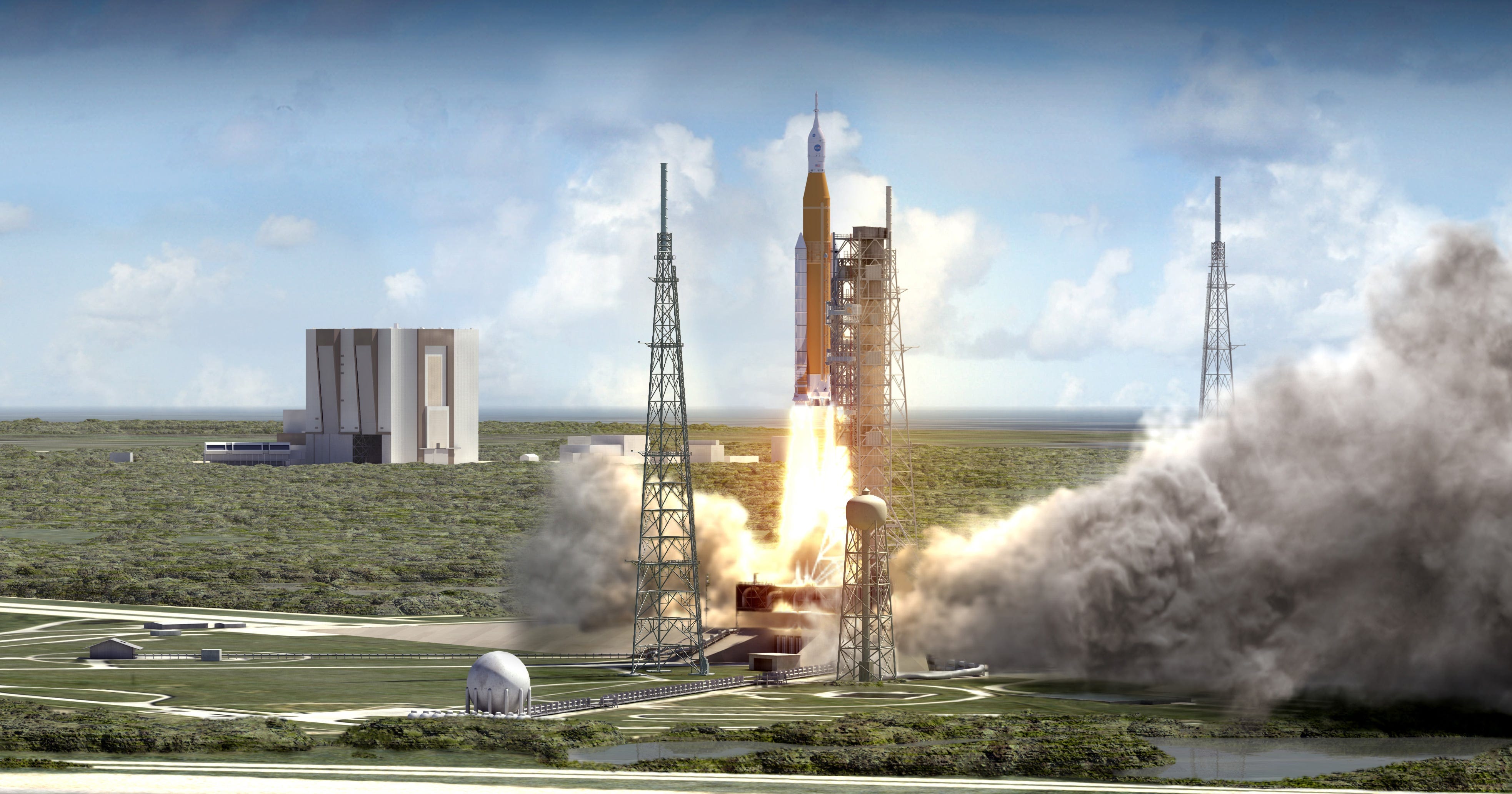
That performance comes at a steep price. According to NASA, each SLS launch with the Orion spacecraft costs $4–4.1 billion — not counting development. That cost is a direct consequence of the architecture. The SLS was built on proven technology and Shuttle-era infrastructure to reduce risk and accelerate development.
The result is a system with outdated supply chains, a low launch cadence, and heavy dependence on a sprawling contractor network. Compared to Falcon 9 and Starship, the SLS is routinely criticized for being more expensive, less flexible, and fully expendable. That last point is key: every SLS is built from scratch, including the RS-25 engines — which were reused across dozens of Shuttle flights but now burn up on every mission.
All of these engineering choices — from the hydrogen engines to the solid boosters — were validated on Artemis 1. Artemis 2 put them through a second check, this time with a crew on board: confirming that the SLS architecture can safely deliver Orion onto a trans-lunar trajectory and is ready for the missions ahead.
The rocket, however, is only the beginning. In the next article, we’ll cover the two remaining pieces of the Artemis architecture: the Orion spacecraft — the capsule that keeps the crew alive across 10 days and nearly half a million kilometers — and the trajectory that brings them home, including the skip reentry technique.
Stay turned!
Before SLS, there was Ares, a rocket thatveould have been larger than SLS. Ares would have used upgraded solid rocket boosters, a 33’ diameter core stage burning H2/lox in the engines from the Delta 4, a big second stage that went through various iterations, & the Orion or other payload on top. This was a giant rocket with a giant price. In the late 00’s. A group was pushing a shuttle derived alt called “Direct”. It was supposed to be cheaper than Ares, but with less payload capability. Once Ares was killed, the SLS was born, somewhat of a political necessity, but also as a hedge for a heavy lift capability. Read about “Direct” here: https://en.wikipedia.org/wiki/DIRECT_%26_Jupiter_Rocket_Family
Also, one quibble, I believe that eve the reason for using the SRBs on the Shuttle was development cost. The budget for designing the Shuttle was constrained & trade off studies showed recoverable liquid fuel boosters (probably with pressure-fed F-1 kerosene/lox engines modified from the Sarurn 5 ) would be cheaper to operate but more expensive to develop than SRBs. Many at NASA wanted liquid fuel boosters but there wasn't the money. In the 1990s NASA again studied liquid boosters as an upgrade, but again it cost too much.