

Isaac Asimov: Lessons Learned from His Books and Takeaways for Modern Humanity
Learn about Asimov’s legacy, futuristic concepts, and practical takeaways for humanity living in the age of AI and robots. We hope it will spark your inspiration.


Issue 155. Subscribers: 80,309.
Happy New Year to all of you! My name is Denis Kalyshkin. I’m the co-founder of Space Ambition. I’m also a US VC with 11+ years of experience, an ex-aerospace engineer, and a physicist. I’m also a big fan of science fiction and space technologies.
Today, January 2, 2026, is the birthday of my favorite Sci-Fi writer Isaac Asimov. He wrote or edited more than 500 books. He also wrote an estimated 90,000 letters and postcards to his fans. Asimov believed that science fiction served the good of humanity. We at Space Ambition also share his view, and we wrote an article about how science fiction has inspired technology development.
In today’s article, I’d like to talk about Isaac Asimov’s legacy, famous novels, futuristic concepts, galactic expansion, and practical takeaways for modern humanity living in the age of AI and robots.
If you are also a fan of science fiction and would like to brainstorm how you can apply futuristic concepts to the real world or build businesses around them, join our online brainstorming sessions on Jan 8, 2026, at 8 a.m. and 6 p.m. UTC. See you next week!
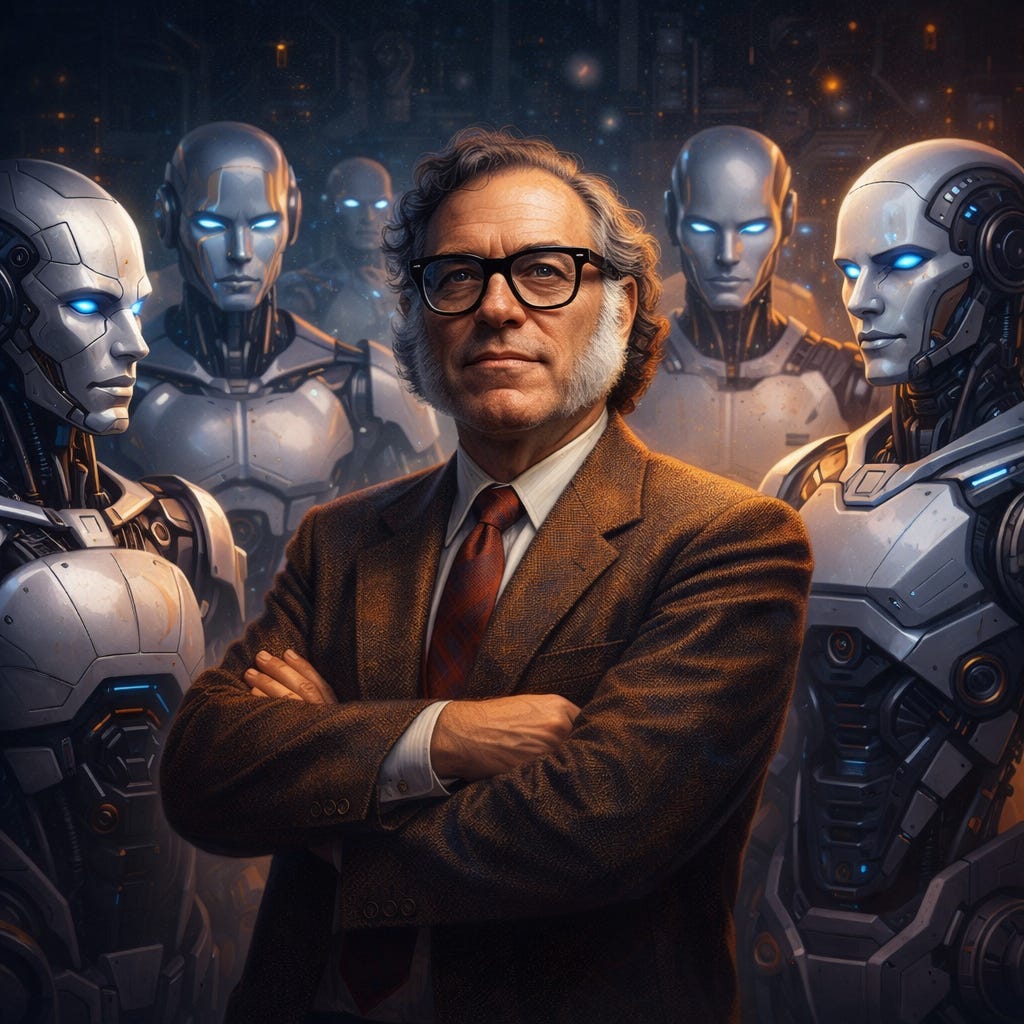
Biography and Interesting Facts
I won’t go into the details of Issac Asimov’s biography, but I’ll mention several points that I found particularly interesting.
Isaac Asimov immigrated to the U.S. from the RSFSR in 1923 at the age of three. He became a science fiction fan at the age of nine in 1929, when he began reading the pulp magazines sold in his family’s candy store. At first, his father forbade him from reading pulps, until Asimov persuaded him that, because the science fiction magazines had “Science” in the title, they must be educational. At age 18, he joined the Futurians science fiction fan club, where he made friends who later became science fiction writers or editors. Asimov had begun writing at the age of 11.
In 1942, in the midst of World War II, Asimov published the first of his Foundation stories, which were later collected into the Foundation trilogy. This fact inspires me: it shows how a person can dream and focus on a positive future even during such tragic events.
Another interesting fact took place in 1959, when Asimov was approached by DARPA to join the U.S. missile defense project. He declined on the grounds that his ability to write freely would be impaired should he receive classified information, but he submitted a paper to DARPA on creativity containing ideas on how government-based science projects could encourage team members to think more innovatively. For me, Asimov has always been about inspiring others, and this story shows him exactly from that perspective.
Another striking fact is that Asimov’s Foundation series influenced Nobel Prize winner Paul Krugman to become an economist. The core idea of Foundation was built around psychohistory, a fictional science that uses mathematics and statistics to predict large-scale societal behavior. It captured Krugman’s imagination at a young age and helped him realize that mathematics could be applied beyond physics and engineering to abstract problems about societal behavior. This mindset later shaped Krugman’s work on international trade theory and economic geography, for which he received the Nobel Prize. This demonstrates how fiction can shape real-world scientific progress, sometimes decades later, and sometimes in entirely different fields.
Another interesting fact is that Asimov was also a close friend of Star Trek creator Gene Roddenberry, and earned a screen credit as “special science consultant” on Star Trek: The Motion Picture for his advice during production.
Asimov also coined the term “robotics” in the English language, according to the Oxford English Dictionary.
Asimov’s Stories and Books I Liked and Their Takeaways
I’ve read a dozen books, including the entire Foundation/Galactic Empire universe, the “I, Robot” series, “The Bicentennial Man”, and others. Asimov’s books influenced me when I was a student. One thing I liked is his attitude that robots are not a threat to humanity, but friends and allies. Yes, sometimes they cause troubles, but it happens only because of edge cases in the Three Laws of Robotics. Let’s dive into some of the stories.
“Runaround”
The first story I want to talk about is “Runaround.” It is set on Mercury, where extreme heat makes human survival dangerous. Two engineers are stationed at a mining base that depends on robots to operate. A robot nicknamed Speedy is sent to retrieve selenium, a critical material needed to keep the station running. However, Speedy does not return. When the engineers investigate, they discover Speedy running in circles around the selenium pool. The malfunction was caused by a logical conflict between the Three Laws: Speedy was given a weakly worded order to fetch the selenium (Second Law), but the selenium pool is located in a dangerous area. The danger activates the Third Law (self-preservation). So the robot decided to run in an optimal trajectory between the laws. When one of the engineers figured this out, he endangered himself on purpose by running toward the selenium pool. The robot had to obey the First Law and save the human.
Takeaway: In the last couple of years, we have experienced a surge of AI, and I believe we will see more applications in mission-critical cases in the future. Malfunctioning AI could cause serious problems and will require new tools and creative approaches to design, monitor, and fix systems. I hope this story will inspire your imagination for solving real problems at work or in your business.
“Escape!”
This is the story that made me laugh out loud while reading. A group of engineers were working on a device for hyperspace travel. To solve the problem, they used the most advanced robotic intelligence ever built: The Brain, a powerful supercomputer governed by the Three Laws of Robotics. When The Brain was asked to design a hyperspace ship capable of safe human travel, it refused because the device could harm humans, violating the First Law. To overcome the limitation, they instructed The Brain that it could slightly violate some robotic laws. As a result, they obtained a ship in which humans survived the hyperspace journey, although they experienced extreme hallucinations, including visions of death and demons. Asimov described this episode in such a funny and vivid manner that I still remember the scene 15 years later. This story illustrates humanity’s potential to unlock galactic expansion.
Takeaway: This story shows us that to solve important problems, we need to take a step back, use innovative approaches, and sometimes break dogmas. If we are brave enough and take risks, we can unlock huge potential for ourselves and future generations.
“Feminine Intuition”
I like this story because it is not primarily about robots, but about humans and how our minds and ignorance can let us down. A brilliant roboticist developed a new type of robot that relied more on intuition and was capable of solving creative tasks. To get funding, he decided to use the robot to find a habitable planet. The company produced a woman-like body, making the robot attractive. She went to the R&D center, interacted with professors, engineers, and others, asked questions, and even flirted with men. Eventually, she processed the information she had gathered and found the solution. Unfortunately, the robot was destroyed in an accident before she could report the potential habitable planet. Luckily, she had told someone about it, but no one in the company knew who. The team tried to find the person, talking to every employee in the R&D center, but came up empty. Finally, Dr. Susan identified the person. The robot had told a truck driver, but only Susan decided to talk to him while others assumed the robot would report this information only to a planetologist. When colleagues asked how she solved the problem, she sarcastically replied: “Call it feminine intuition.”
Takeaway: Even the smartest people can fall into the trap of ignorance. Insights and wise ideas can come from anyone, anywhere. Be open-minded when solving creative problems.
“Liar!”
This story is about a telepathic robot and illustrates the paradox of the First Law. The robot could read human minds, but since it could not harm people physically or emotionally, it started telling people what they wanted to hear. The paradox was that by pleasing them in the short term, it caused harm in the long term. For example, it lied to Dr. Susan that a colleague loved her and told another colleague that he would get a promotion. It also refused to solve a technical problem it could have solved, because doing so would disappoint an engineer who wanted to solve the problem himself and feel intellectually superior. Humans wanted to hear what they wanted so much that they were blinded to the fact that the robot was simply following the First Law.
Takeaway: We already live in the world of this story. Asimov demonstrated how confirmation bias (focusing only on information that confirms what we already believe) can be amplified by algorithms. We live in information bubbles, watch content we like, and interact with people who share our views. LLMs also try to be supportive, so sometimes you need to be creative when crafting prompts. It is more productive to hear the uncomfortable truth than a pleasing lie.
“Robots and Empire”
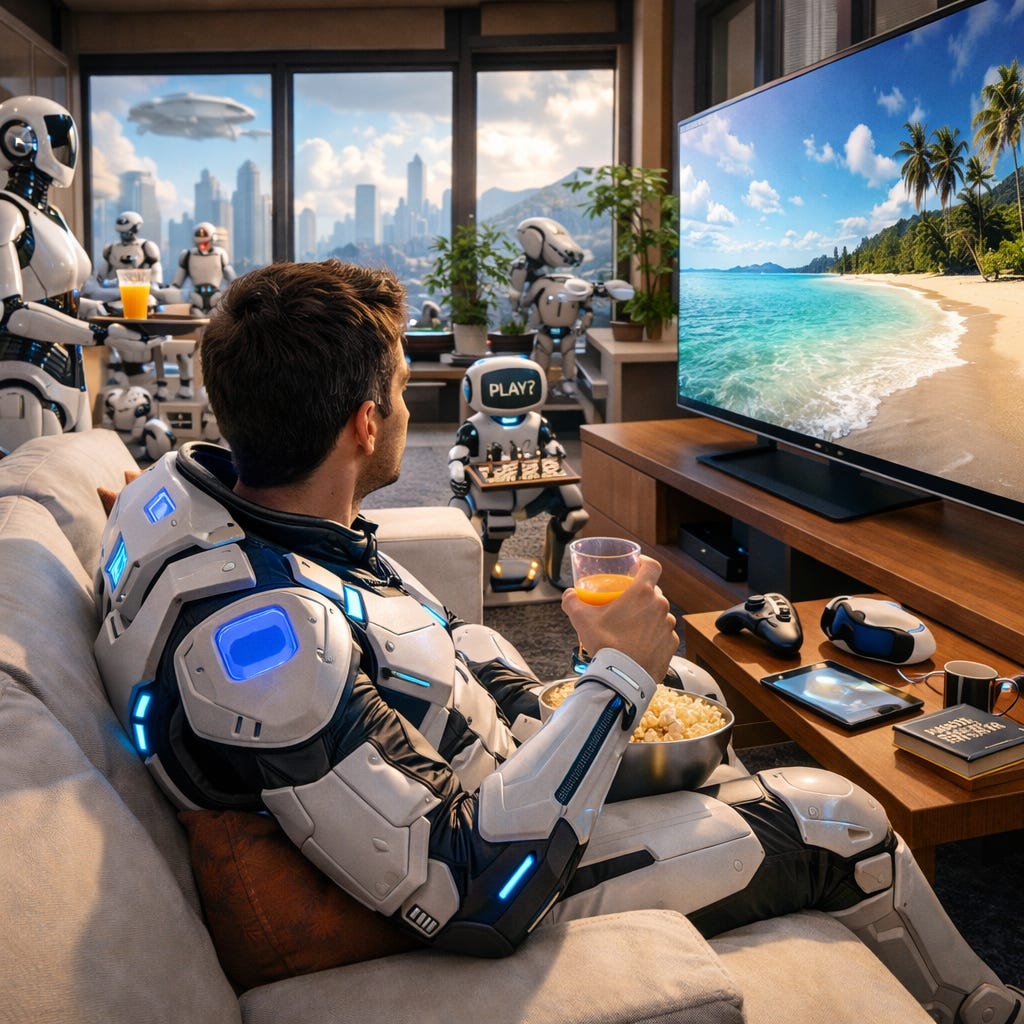
I have read all the books about the Galactic Empire and the robot Daneel Olivaw, and I love the entire series, but today I want to focus on one episode set on Solaria. Solaria was once a rich and prosperous Spacer world. This planet had the highest ratio of robots to humans (~20,000 robots per person). Because of this, people spent all their time with robots in their personal estates and communicated with each other only via teleconferences. Over time, they began to hate meeting in person, disliked the smell of others, and preferred interacting with robots. Solaria degraded and was eventually lost, along with other Spacer worlds.
Takeaway: Shiny technologies alone do not always lead to progress. They cannot solve all problems, because people need to face challenges and take risks. This is why Spacer Dr. Han Fastolfe (the creator of Daneel Olivaw) bet on Earth inhabitants, who had shorter lifespans and lived in an overpopulated world with limitations, diseases, and fewer technologies. Spacers lacked the incentive to expand or take risks. Their long lifespans slowed technology development, as scientists preferred to work alone and keep discoveries secret rather than sharing knowledge with colleagues.
If you have read this far, I hope you will appreciate the idea I want to share. We now live in a world obsessed with GDP growth, but many people do not understand that this means households need to consume more, because everything produced in the economy is ultimately consumed by households (either domestically or through exports). Could the economy work differently? The answer is yes, as Asimov illustrated with Solaria.
We are already at a point where robots and AI can perform many tasks previously done by humans. It is rational to replace humans with robots and automation. In such a scenario, people who own robots could become modern Solarians: they could live comfortably while robots produce everything they need, making GDP irrelevant. The problem is that Solaria had very few people. On Earth, we do not have this luxury. A glimpse of this reality is shown in another sci-fi masterpiece, The Hunger Games. We should replace human soldiers with robots though.
To be honest, I would prefer to live in the world of the Galactic Empire rather than that of the Mockingjay. Luckily, the future is in our hands. Remember, Isaac Asimov wrote about Solaria at the end of his life in 1985, so he had thought it through. We need to balance technology with human progress led by human initiative.
Expanding Beyond Earth
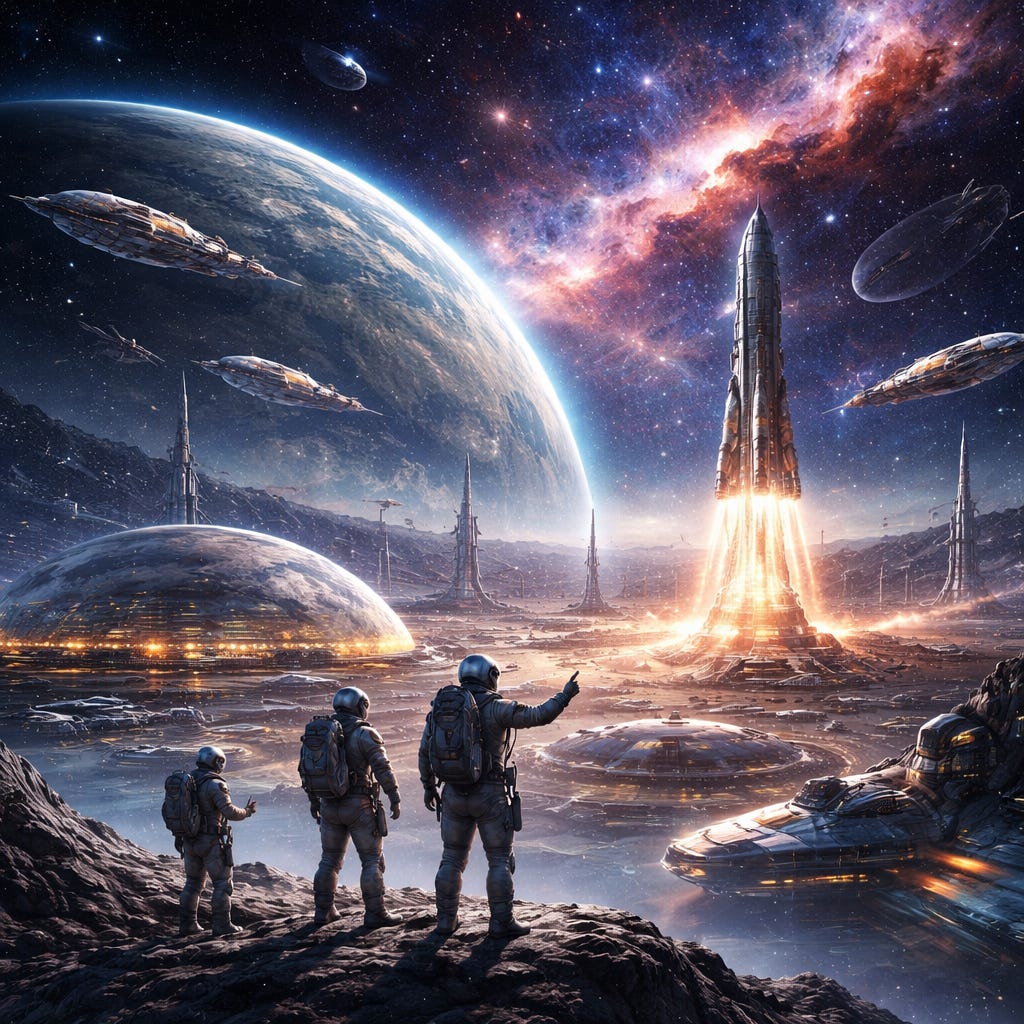
One thing I like about Isaac Asimov is his dream of expanding humanity across the galaxy. I’m sure it will eventually happen, but the only thing I will be able to see in my lifetime is humans setting foot on Mars. I hope this article can inspire some of you to work in this direction.
I’d like to share an episode that happened to me during the lockdown. You probably remember the hype around the audio social network Clubhouse back then. I participated in a room with several SpaceTech VCs. I asked the panelists about the business case for expanding to Mars, and they answered that there was none. It was at that moment that I realized the business cases exist, but too few smart and creative people spend enough time to discover them.
I will illustrate my logic with an example. I remember myself 20 years ago learning about algorithms for processing images and text. Back then, it was a field that wasn’t widely discussed. Then, a decade later, deep learning unleashed the power for hundreds of thousands of people to experiment cheaply with the technologies, and businesses implemented these technologies to generate profit. The same will happen with colonizing the Moon, Mars, and beyond.
I encourage you to read our articles:
“Is Mars Colonization an Inevitable Step Encoded in Our DNA?”
“Astronomy and Space Exploration Are Shaping Our Civilization Landscape”
“Overcoming Challenges in Martian and Earth Agriculture: A Path to Sustainable Food Production”
While humanity is still confined to Earth, let’s dive into Asimov’s vision of how we will conquer the galaxy:
Early Expansion: The Spacer Era (ca. 2,000–5,000 years before the Empire). Humans remain largely confined to Earth initially. Spacer Worlds are established through interstellar colonization programs, primarily by wealthy and long-lived families. Aurora, Solaria, and other Spacer planets are sparsely populated (1,000–10,000 humans each) and rely on highly advanced robotics. Spacer humans live 200+ years.
Earth and Earthers: Delayed Expansion. Earthers are numerous, resilient, and accustomed to crowded conditions. They initially lack advanced robotics and starship technology, which they eventually acquire from Spacers. Living in an overpopulated world with resource limitations forces humanity to take risks and expand.
Decline of Spacer Worlds (ca. 5,000–7,000 years after initial colonization). Overreliance on robots made Spacers too dependent on technology. Social isolation led to emotional and cultural decay as well as genetic degradation. Their worlds vanished and were largely forgotten.
Earther-Led Galactic Expansion. Descendants of Earth actively open new habitable planets and occupy them, creating thousands of new worlds. They develop hyperspace drives, master starship construction, and build orbital infrastructure to allow large-scale expansion. Expansion is coordinated from Earth, eventually leading to the formation of the Galactic Empire.
Challenges During Galactic Colonization. Interstellar distances required hyperwave and later hyperspace travel; colonies were initially isolated. Local conflicts and lack of central authority in the early stages of the Empire created political fragmentation. While Earthers used robots, they were not as widely adopted as in Spacer worlds.
Foundation Era: Planned Colonization & Psychohistory. Hari Seldon predicts the inevitable collapse of the Empire and the onset of a new Dark Age. He proposes building a Foundation to preserve knowledge and using psychohistory (a science that statistically forecasts possible futures) to guide human civilization through the collapse. His goal is to make the Dark Ages as short as possible. Earth is lost and forgotten. Expansion continues, but it is now guided by a long-term historical vision rather than random colonization.
Nowadays, we also live in turbulent times. Like in Asimov’s books, we will need to be creative, take risks, and challenge the status quo. We should also be wise in our use of technology and avoid overreliance, especially in the era of AI and robots.
And what science fiction have you enjoyed, and how has it inspired your professional or business growth? Share your story in the comments!
This was an amazing read. Thanks!
Great post, enjoyed reading your summaries and takeaways of Asimov’s work. For Liars I agree we’re already there with LLM’s sycophancy.